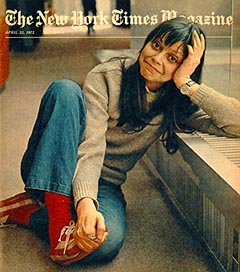
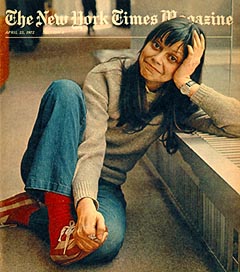
 Το γράμμα του 13-χρονου(;;) μαθητή που δημοσιεύθηκε στο πρωτοσέλιδο της "Ελευθεροτυπίας" (07/11/2006) μού θύμισε το άρθρο της 18-χρονης Joyce Maynard που δημοσιεύθηκε 34 χρόνια πριν στο New York Times Magazine. Πρόκειται για ενδιαφέρουσα μαρτυρία εποχής, ειλικρινέστερη βεβαίως του κατασκευάσματος της "Ελευθεροτυπίας".Σημειώνεται ότι το άρθρο αυτό υπήρξε η αφορμή της γνωριμίας του συγγραφέως J. D. Salinger με την Maynard, γνωριμίας που εξελίχθηκε σε σύντομη, αμφιλεγόμενη σχέση.Αντιγράφω από την ιστοσελίδα της Joyce Maynard
 (
http://www.joycemaynard.com/columns-articles/eighteen-yr-old-looks-back.shtml)
Originally published April 23, 1972 - New York Times Magazine (The following is a portion of the original column.)
"Every generation thinks it's special - my grandparents because they remember horses and buggies, my parents because of the Depression. The over-30's are special because they knew the Red Scare of Korea, Chuck Berry and beatniks. My older sister is special because she belonged to the first generation of teen-agers (before that, people in their teens were adolescents), when being a teen-ager was still fun. And I - I am 18, caught in the middle. Mine is the generation of unfulfilled expectations. "When you're older," my mother promised, "you can wear lipstick." But when the time came, of course, lipstick wasn't being worn. "When we're big, we'll dance like that," my friends and I whispered, watching Chubby Checker twist on "American Bandstand." But we inherited no dance steps, ours was a limp, formless shrug to watered-down music that rarely made the feet tap. "Just wait till we can vote," I said, bursting with 10-year-old fervor, ready to fast, freeze, march and die for peace and freedom as Joan Baez, barefoot, sang "We Shall Overcome." Well, now we can vote, and we're old enough to attend rallies and knock on doors and wave placards, and suddenly it doesn't seem to matter any more.
My generation is special because of what we missed rather than what we got, because in a certain sense we are the first and the last. The first to take technology for granted. (What was a space shot to us, except an hour cut from Social Studies to gather before a TV in the gym as Cape Canaveral counted down?) The first to grow up with TV. My sister was 8 when we got our set, so to her it seemed magic and always somewhat foreign. She had known books already and would never really replace them. But for me, the TV set was, like the kitchen sink and the telephone, a fact of life.
We inherited a previous generation's hand-me-downs and took in the seams, turned up the hems, to make our new fashions. We took drugs from the college kids and made them a high-school commonplace. We got the Beatles, but not those lovable look-alikes in matching suits with barber cuts and songs that made you want to cry. They came to us like a bad joke - aged, bearded, discordant. And we inherited the Vietnam war just after the crest of the wave - too late to burn draft cards and too early not to be drafted. The boys of 1953 - my year - will be the last to go.
So where are we now? Generalizing is dangerous. Call us the apathetic generation and we will become that. Say times are changing, nobody cares about prom queens and getting into the college of his choice any more - say that (because it sounds good, it indicates a trend, gives as symmetry to history) and you make a movement and a unit out of a generation unified only in its common fragmentation. If there is a reason why we are where we are, it comes from where we have been.
Like overanxious patients in analysis, we treasure the traumas of our childhood. Ours was more traumatic than most. The Kennedy assassination has become our myth: Talk to us for an evening or two - about movies or summer jobs or Nixon's trip to China or the weather - and the subject will come up ("Where were you when you heard?"), as if having lived through Jackie and the red roses, John-John's salute and Oswald's on-camera murder justifies our disenchantment.
We haven't all emerged the same, of course, because our lives were lived in high-school corridors and drive-in hamburger joints as well as in the pages of Time and Life, and the images on the TV screen. National events and personal memory blur so that, for me, Nov. 22, 1963, was a birthday party that had to be called off and Armstrong's moonwalk was my first full can of beer. If you want to know who we are now; if you wonder how we'll vote, or whether we will, or whether, 10 years from now, we'll end up just like all those other generations that thought they were special - with 2.2 kids and a house in Connecticut - if that's what you're wondering, look to the past because, whether we should blame it or not, we do.
I didn't know till years later that they called it the Cuban Missile Crisis. But I remember Castro. (We called him Castor Oil and were awed by his beard - beards were rare in those days.) We might not have worried so much (what would the Communists want with our small New Hampshire town?) except that we lived 10 miles from an air base. Planes buzzed around us like mosquitoes that summer. People talked about fallout shelters in their basements and one family on our street packed their car to go to the mountains. I couldn't understand that. If everybody was going to die, I certainly didn't want to stick around, with my hair falling out and - later - a plague of thalidomide-type babies. I wanted to go quickly, with my family.
Dying didn't bother me so much - I'd never known anyone who died, and death was unreal, fascinating. (I wanted Doctor Kildare to have more terminal cancer patients and fewer love affairs.) What bothered me was the business of immortality. Sometimes, the growing-up sort of concepts germinate slowly, but the full impact of death hit me like a bomb, in the night. Not only would my body be gone - that I could take - but I would cease to think. That I would no longer be a participant I had realized before; now I saw that I wouldn't even be an observer. What especially alarmed me about The Bomb (always singular like, a few years later, The Pill) was the possibility of total obliteration. All traces of me would be destroyed. There would be no grave and, if there were, no one left to visit it.
Newly philosophical, I pondered the universe. If the earth was in the solar system and the solar system was in the galaxy and the galaxy was in the universe, what was the universe in? And if the sun was just a dot - the head of a pin - what was I? We visited a planetarium that year, in third grade, and saw a dramatization of the sun exploding. Somehow the image of that orange ball zooming toward us merged with my image of The Bomb. The effect was devastating and for the first time in my life - except for Easter Sundays, when I wished I went to church so I could have a fancy new dress like my Catholic and Protestant friends - I longed for religion.
I was 8 when Joan Baez entered our lives, with long, black, beatnik hair and a dress made out of a burlap bag. When we got her first record (we called her Joan Baze then - soon she was simply Joan) we listened all day, to "All My Trials" and "Silver Dagger" and "Wildwood Flower." My sister grew her hair and started wearing sandals, make pilgrimages to Harvard Square. I took up the guitar. We loved her voice and her songs but, even more, we loved the idea of Joan, like the 15th-century Girl of Orleans, burning at society's stake, marching along or singing solitary, in a prison cell to protest segregation. She was the champion of nonconformity and so - like thousands of others - we joined the masses of her fans.
I knew she must but somehow I could never imagine Jackie Kennedy going to the bathroom. She was too cool and poised and perfect. We had a book about her, filled with color pictures of Jackie painting, in a spotless yellow linen dress, Jackie on the beach with Caroline and John-John, Jackie riding elephants in India and Jackie, in a long white gown, greeting Khrushchev like Snow White welcoming one of the seven dwarfs. (No, I wasn't betraying Joan in my adoration. Joan was beautiful but human, like us; Jackie was magic.) When, years later, she married Rumpelstiltskin, I felt like a child discovering, in his father's drawer, the Santa Claus suit. And, later still, reading some Ladies' Home Journal exposé ("Jacqueline Onassis's secretary tells all . . .") I felt almost sick. After the first few pages I put the magazine down. I wasn't interested in the fragments, only in the fact that the glass had broken. "
H Joyce Maynard, 53 ετών σήμερα, δεν βλέπει πια πίσω, αλλά μπροστά, και χρεώνει 5 δολλάρια για ανατυπώσεις του πλήρους άρθρου!!!